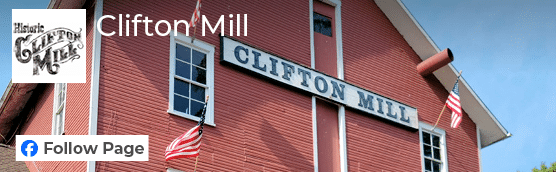
Welcome to Clifton Mill
|
!!!!
COMING SEPTEMBER 13, 2008 !!!! Flour Power - "how flour had the power to build a town"
Historic Clifton Mill is one of the largest water powered grist mills still in existence. The first mill at this site was built in 1802 by Owen Davis, a Revolutionary War soldier and frontiersman miller. The mill was built in this location to take advantage of the natural power of the concentrated water funneled into the gorge. Owen Davis and his son-in-law, General Benjamin Whiteman also built a saw mill and a distillery. Soon a village known as Davis Mills sprang up around the mills. The Little Miami River powered five other mills that were built within a mile of Clifton Mill; a woolen mill, saw mill, paper mill, barrel mill and another grist mill. Clifton Mill is the only one still standing. Around 1810 Davis sold his grist mill to Robert Patterson, father of the founders of NCR. Patterson renamed the village Cliff Town, had it surveyed into lots and officially made a town whose name was shortened to Clifton. Clifton grew rapidly and at one point had a population three times that of today with blacksmith shops, a butcher shop, two churches, a school, a hotel, two grocers, weavers, shoemakers, paper makers and more. Due to Robert Patterson being made Quartermaster, Clifton played a part in the War of 1812. Clifton Mill provided corn meal for federal troops from this part of Ohio, while Patterson's woolen mill provided cloth and buttons for uniforms. Robert Patterson sold Clifton Mill to the Armstrong family who ran the mill for more than 20 years. Then three generations of the Preston family ran the mill till 1948. Many years and several owners later, the Satariano family purchased the mill to preserve such an historic and beautiful piece of property. More Mill History.
Clifton Mill is the perfect place for your next special event. The historical charm of the old mill plus the spectacular views of nature make Clifton Mill a unique place for any type of gathering. Clifton Mill is proud to be a member of SPOOM, the Society for the Preservation Of Old Mills. |
|
|